Spin
Balls may be spun to alter their bounce (for example, topspin and backspin in tennis) or trajectory, and players may slice the ball (strike it with an angled racquet face) to produce such spin. The shuttlecock is not allowed to bounce, but slicing the shuttlecock does have applications in badminton. (See Basic strokes for an explanation of technical terms.)
1. Slicing the shuttlecock from the side may cause it to travel in a different direction from the direction suggested by the player's racquet or body movement. This is used to deceive opponents.
2. Slicing the shuttlecock from the side may cause it to follow a slightly curved path (as seen from above), and the deceleration imparted by the spin causes sliced strokes to slow down more suddenly towards the end of their flight path. This can be used to create drop shots and smashes that dip more steeply after they pass the net.
3. When playing a net shot, slicing underneath the shuttlecock may cause it to turn over itself (tumble) several times as it passes the net. This is called a spinning net shot or tumbling net shot. The opponent will be unwilling to address the shuttlecock until it has corrected its orientation.
Due to the way that its feathers overlap, a shuttlecock also has a slight natural spin about its axis of rotational symmetry. The spin is in a counter-clockwise direction as seen from above when dropping a shuttlecock. This natural spin affects certain strokes: a tumbling net shot is more effective if the slicing action is from right to left, rather than from left to right.
Vertical position of shuttlecocks

When the shuttlecock is well below net height, players have no choice but to hit upwards. Lifts, where the shuttlecock is hit upwards to the back of the opponents' court, can be played from all parts of the court. If a player does not lift, their only remaining option is to push the shuttlecock softly back to the net: in the forecourt, this is called a net shot; in the midcourt or rear court, it is often called a push or block.
When the shuttlecock is near to net height, players can hit drives, which travel flat and rapidly over the net into the opponents' rear midcourt and rear court. Pushes may also be hit flatter, placing the shuttlecock into the front midcourt. Drives and pushes may be played from the midcourt or forecourt, and are most often used in doubles: they are an attempt to regain the attack, rather than choosing to lift the shuttlecock and defend against smashes. After a successful drive or push, the opponents will often be forced to lift the shuttlecock.
Biomechanics
Badminton biomechanics have not been the subject of extensive scientific study, but some studies confirm the minor role of the wrist in power generation and indicate that the major contributions to power come from internal and external rotations of the upper and lower arm. Recent guides to the sport thus emphasize forearm rotation rather than wrist movements.
The feathers impart substantial drag, causing the shuttlecock to decelerate greatly over distance. The shuttlecock is also extremely aerodynamically stable: regardless of initial orientation, it will turn to fly cork-first and remain in the cork-first orientation.
One consequence of the shuttlecock's drag is that it requires considerable power to hit it the full length of the court, which is not the case for most racquet sports. The drag also influences the flight path of a lifted (lobbed) shuttlecock: the parabola of its flight is heavily skewed so that it falls at a steeper angle than it rises. With very high serves, the shuttlecock may even fall vertically.
Other Factors
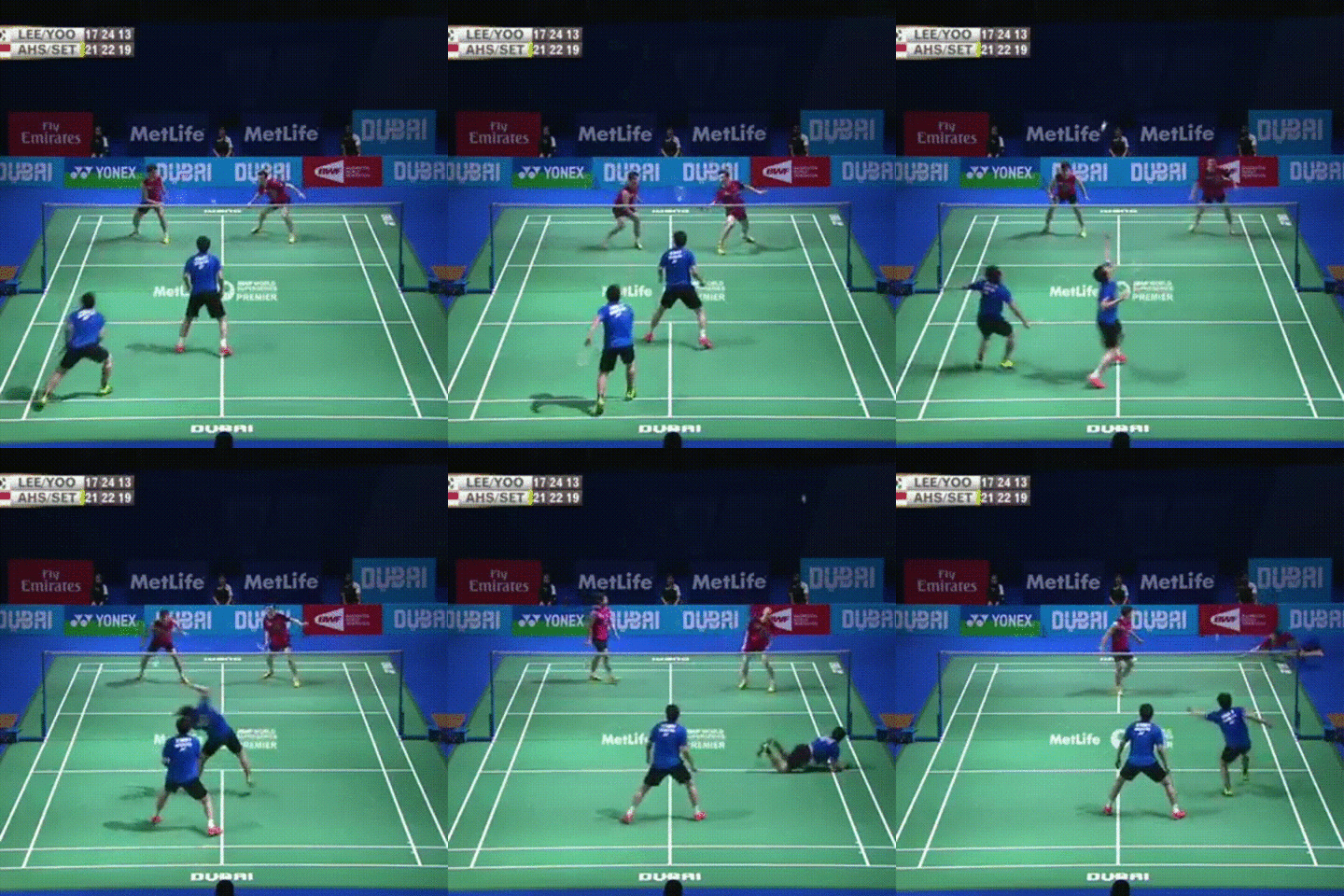
When defending against a smash, players have three basic options: lift, block, or drive. In singles, a block to the net is the most common reply. In doubles, a lift is the safest option but it usually allows the opponents to continue smashing; blocks and drives are counter-attacking strokes but may be intercepted by the smasher's partner. Many players use a backhand hitting action for returning smashes on both the forehand and backhand sides because backhands are more effective than forehands at covering smashes directed to the body. Hard shots directed towards the body are difficult to defend.
The service is restricted by the Laws and presents its own array of stroke choices. Unlike in tennis, the server's racquet must be pointing in a downward direction to deliver the serve so normally the shuttle must be hit upwards to pass over the net. The server can choose a low serve into the forecourt (like a push), or a lift to the back of the service court, or a flat drive serve. Lifted serves may be either high serves, where the shuttlecock is lifted so high that it falls almost vertically at the back of the court, or flick serves, where the shuttlecock is lifted to a lesser height but falls sooner.