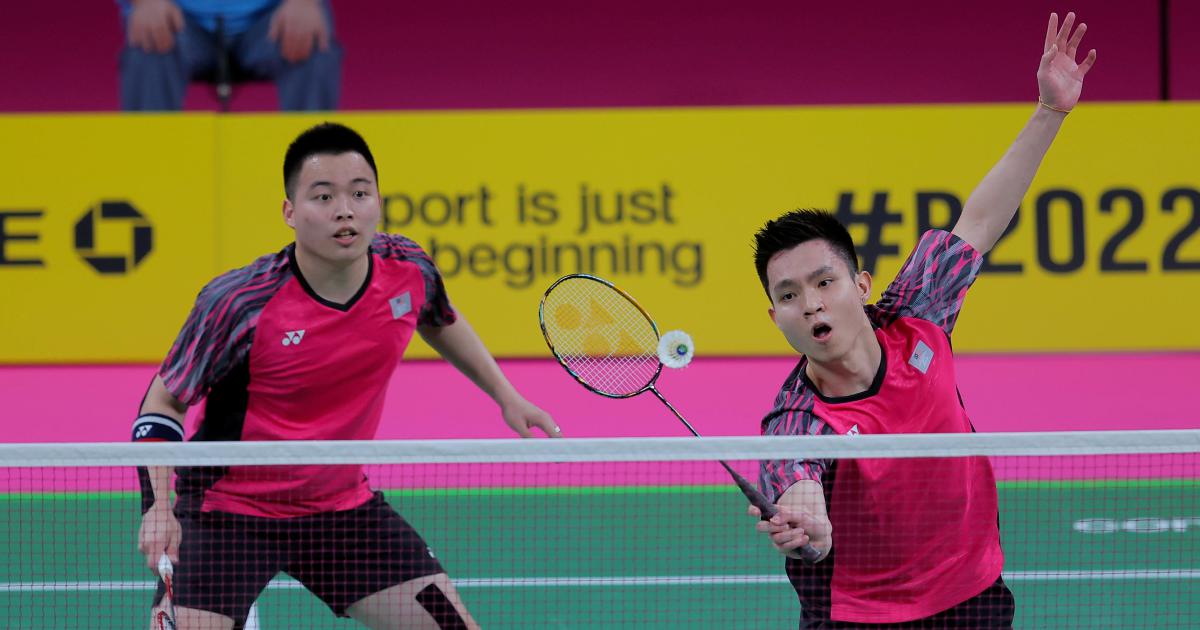
Both pairs will try to gain and maintain the attack, smashing downwards when the opportunity arises. Whenever possible, a pair will adopt an ideal attacking formation with one player hitting down from the rear court, and their partner in the midcourt intercepting all smash returns except the lift. If the rear court attacker plays a drop shot, their partner will move into the forecourt to threaten the net reply. If a pair cannot hit downwards, they will use flat strokes in an attempt to gain the attack. If a pair is forced to lift or clear the shuttlecock, then they must defend: they will adopt a side-by-side position in the rear midcourt, to cover the full width of their court against the opponents' smashes. In doubles, players generally smash to the middle ground between two players in order to take advantage of confusion and clashes
At high levels of play, the backhand serve has become popular to the extent that forehand serves have become fairly rare at a high level of play. The straight low serve is used most frequently, in an attempt to prevent the opponents gaining the attack immediately. Flick serves are used to prevent the opponent from anticipating the low serve and attacking it decisively.
At high levels of play, doubles rallies are extremely fast. Men's doubles are the most aggressive form of badminton, with a high proportion of powerful jump smashes and very quick reflex exchanges. Because of this, spectator interest is sometimes greater for men's doubles than for singles.